Covis | How to Read Expert Metrics: Win Rate, Return, Reputation
COVIS · EPISODE 4
A 94.8% win rate.
Is that the whole story?
Win rate, cumulative return, monthly return, reputation score: we read the numbers on an expert profile exactly as the screen presents them.
Stop staring at charts alone. Watch the pros' entries right beside them.
When you choose an expert, the first thing that catches your eye is the big number. But even the same "+92.86%" cannot be compared unless you know what was added up to get it, and whether leverage went in.
In this post we lay out the metrics on a Covis expert profile in the screen's own explanation. Some numbers are better the higher they are, and some only mean something when read together with others.
On the expert list: four things in one row
Grade, reputation rank, 30-day return and win rate at a glance.
One row of the expert list holds the grade (A, B, C) next to the name, the reputation rank, the Live account badge, and the 30-day return, win rate and subscriber count. You can sort by Reputation, Newest, Subscribers or Return.
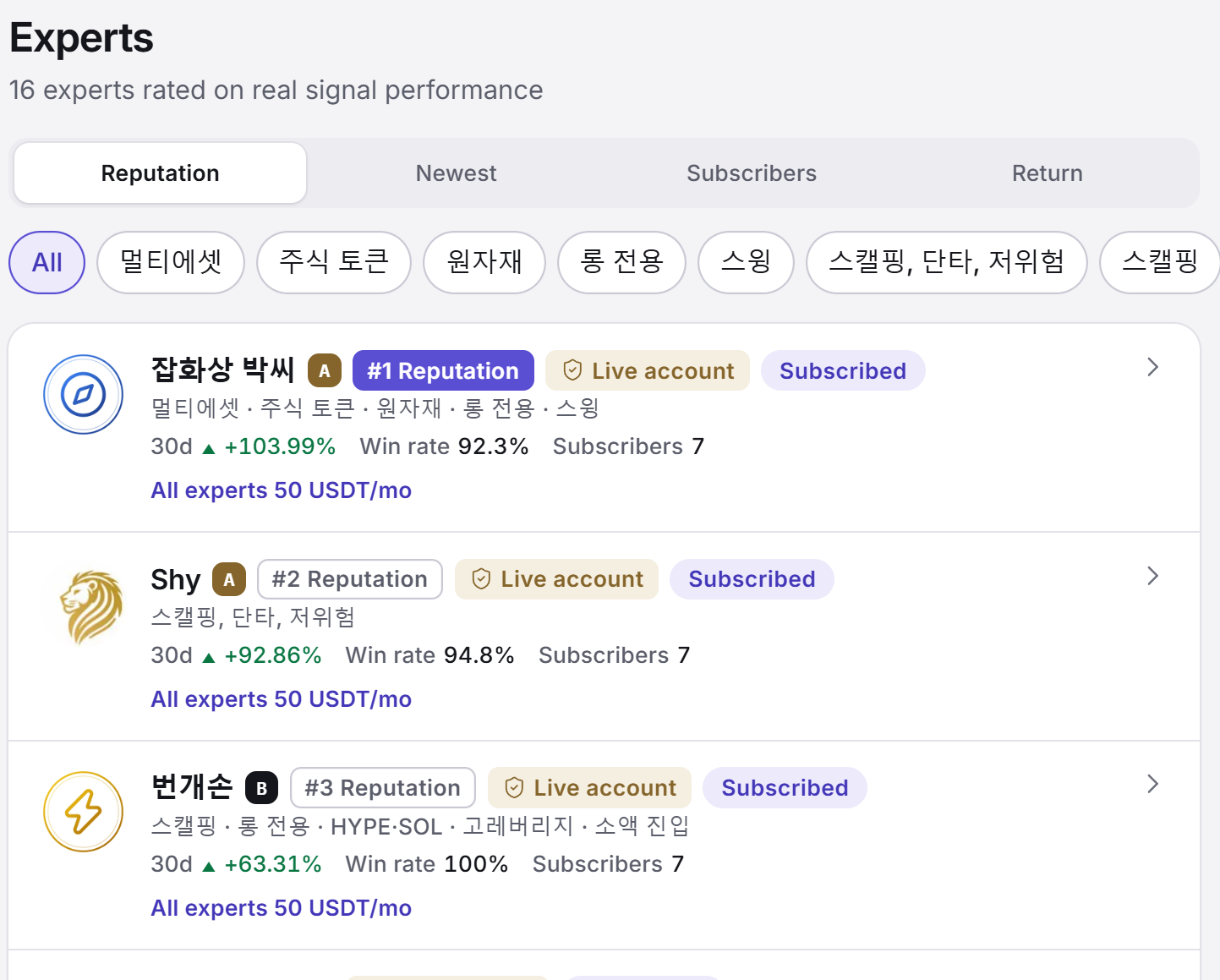
The screen above shows the top experts, ahead on returns. Every expert in the same list is shown in the same format, which makes the eye for reading numbers matter even more. The short descriptions under the names are written by the experts themselves, so some are in Korean even on the English site.
At the top of a profile: 30d win rate, cumulative return, closed signals
All three numbers are based on "signals closed in the last 30 days."
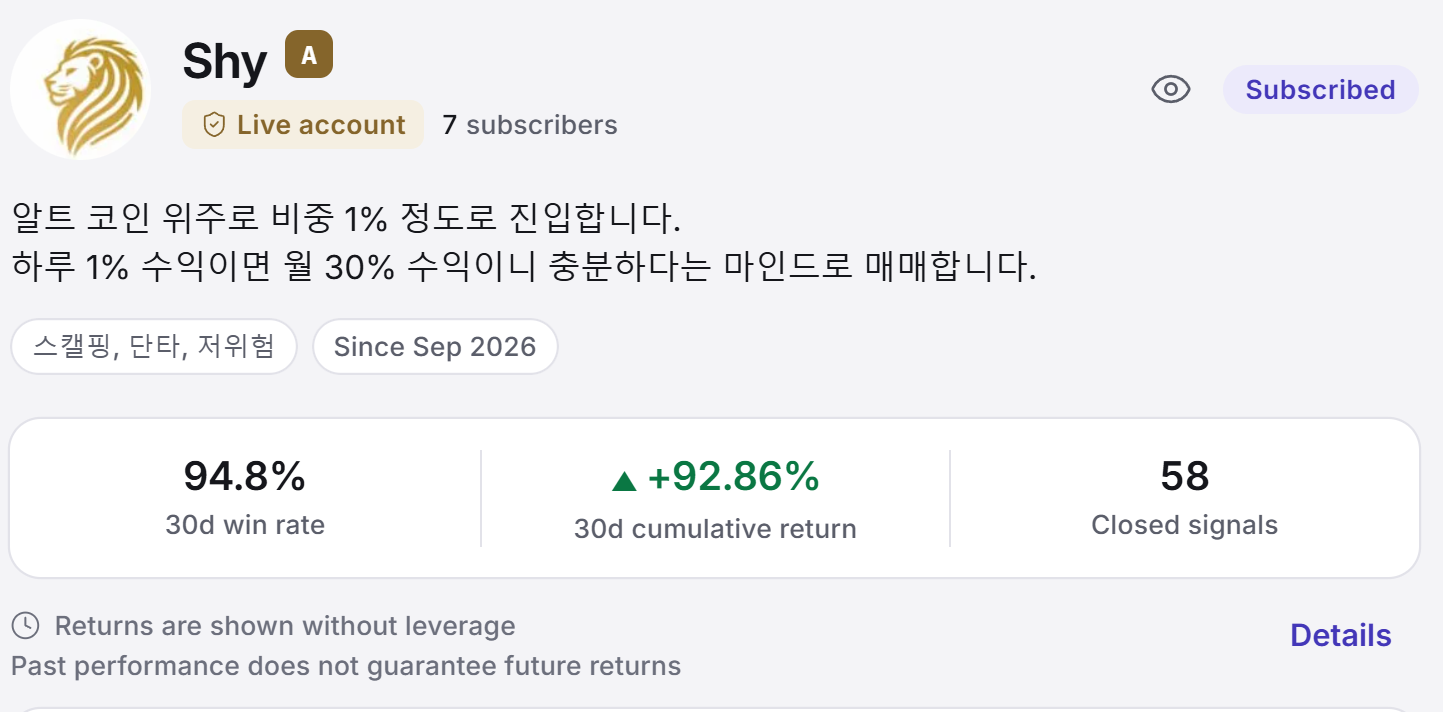
- 30d win rate: the share of signals closed in the last 30 days that were winners
- 30d cumulative return: the price return of each closed signal, from entry to exit, all added together
- Closed signals: how many signals the numbers above rest on (58 on this screen)
Read the count alongside. Even a 100% win rate means there is still little to judge by if only a few signals have closed. And right below, the line "Returns are shown without leverage. Past performance does not guarantee future returns" is always displayed.
Monthly return: consistency shows up as bars
Look at the shape across months, not one big month.
The Monthly return in the middle of the profile shows the last 12 months as bars. It is the signals closed that month, added up the same way, and months with no record show as "No record."
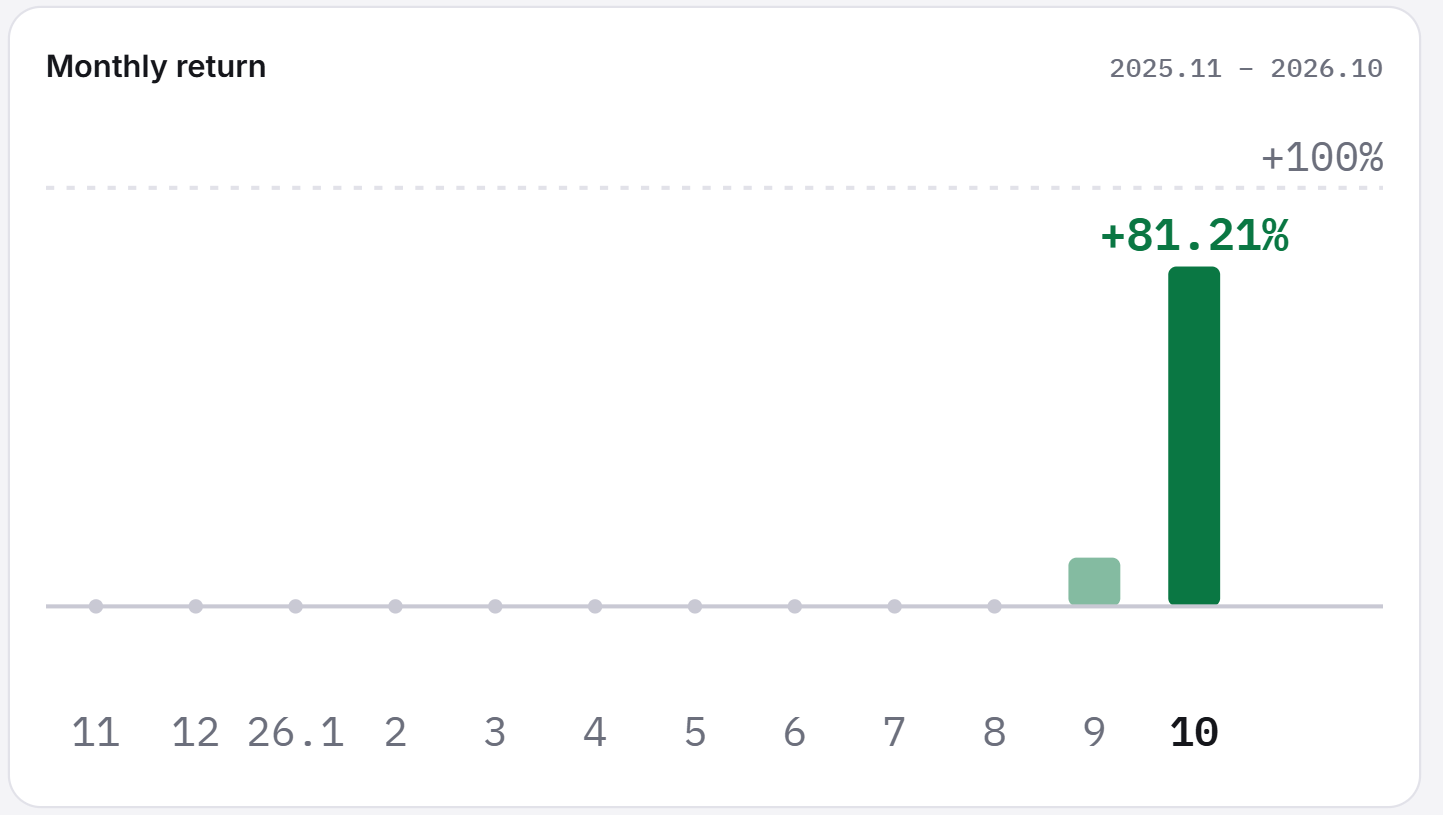
This expert began in September 2026, so there are only two bars. With a short record, even a high number does not yet tell you whether it will continue. On the other hand, bars that run on across many months are the evidence of consistency.
Press "Details": how the reputation score is built
Reputation is performance 50, subscribers 20, activity 15 and content 15 points.
Press Details on the profile and the screen spells out how the numbers are calculated. The return with leverage, the number of signals judged in 30 days, open signals, signals per 30 days, and the reputation score all appear together.
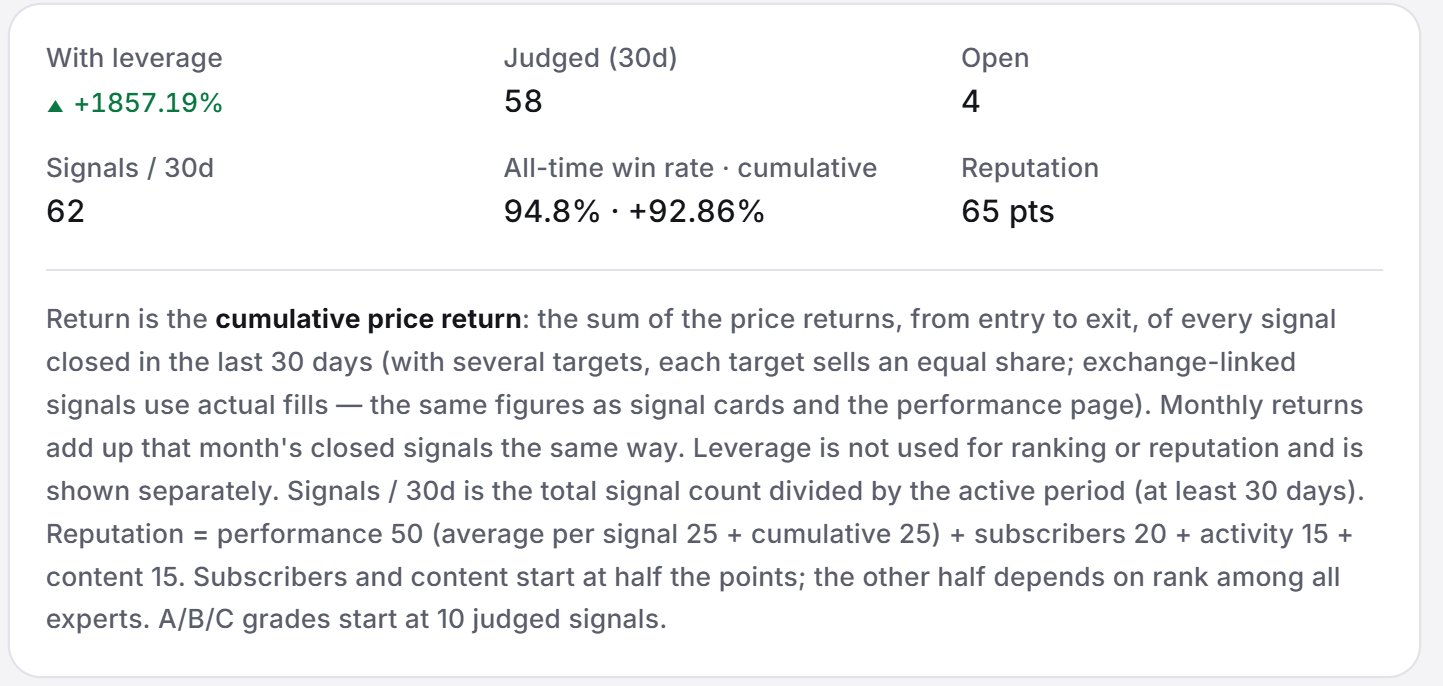
- Leverage is shown separately: it is not used for ranking or reputation, and appears as its own number. On this screen the return with leverage comes out far larger, but losses grow by the same multiple.
- Reputation score: made up of performance 50 points (average per signal 25 + cumulative 25), subscribers 20, activity 15 and content 15.
- Grade: A, B and C grades are assigned from 10 judged signals. An expert with no grade yet needs more record to build up.
It is also worth noticing that activity and subscriber response count, not just the performance score. Someone who stays active steadily has the edge in reputation over someone who made a lot once.
Replace the subscription fee with an exchange sign-up
The subscription fee can be replaced by an exchange referral registration.
Covis's subscription fee can be replaced by registering through an exchange referral.
Signing up with the Gate exchange is covered in a guide you can follow screen by screen.
Win rate and cumulative return are based on signals closed in the last 30 days
Read the number of closed signals alongside to know how much a figure weighs
Returns are shown without leverage, and leverage is shown separately
Use the monthly return bars to check consistency and the length of the record
Reputation is performance 50 · subscribers 20 · activity 15 · content 15 points
Next, episode 5: how to choose an expert. We sort out which experts to look at first, based on these metrics.


