Covis | How to Choose a Coin Signal Expert: Style Tags, Grade, Closed Signals
COVIS · EPISODE 5
The pro that fits you
narrows down to one tag.
Style tags, grade, how long they've been active, how many signals they've closed: the criteria for choosing an expert, read off the real screens.
Stop staring at charts alone. Watch the pros' entries right beside them.
"Whom should I follow?" It is the first question you hit when you set out to pick a coin-signal expert. A single return number is not enough to decide, because people trade in very different ways. Some get in and out several times a day, and others move only once or twice a month.
Covis shows that difference first, as a style tag. Pick the way you want to watch with one tag and the list narrows right away. Then you check the grade and the record.
The expert list: start with sorting and tags
Four ways to sort, and one row of style tags, is your starting point.
At the top of the expert list you can sort by Reputation, Newest, Subscribers or Return. The row of style tag buttons right below it holds trading styles such as 멀티에셋 (multi-asset), 주식 토큰 (stock tokens), 원자재 (commodities), 롱 전용 (long only), 스윙 (swing) and 스캘핑 (scalping). Experts write these tags themselves, so they appear in Korean even on the English site. Each row also shows the grade next to the name, the reputation rank, the Live account badge, and the 30-day return and win rate.
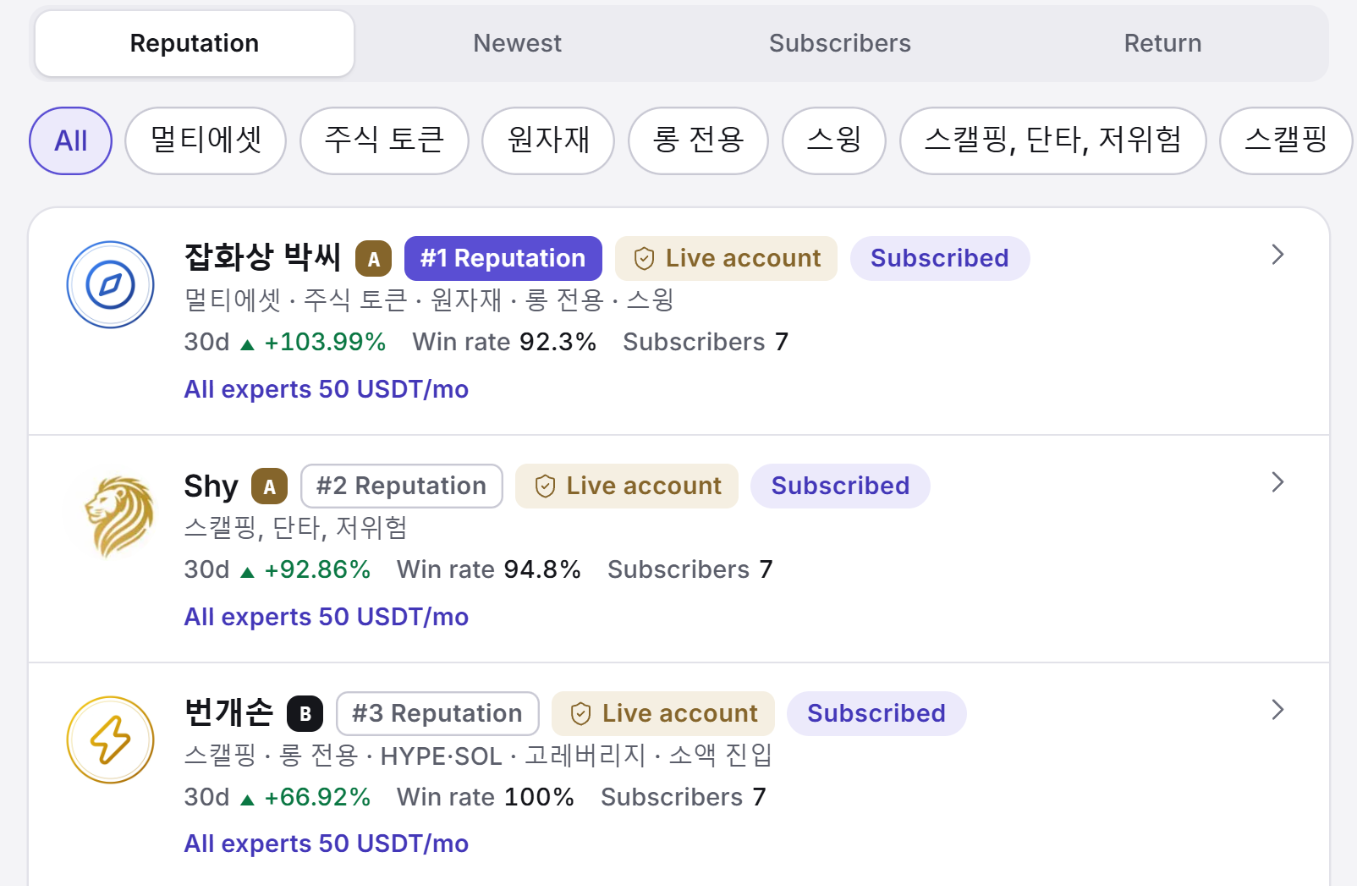
The line of tags under each name is that person's way of trading. 잡화상 박씨 is 멀티에셋 · 주식 토큰 · 원자재 · 롱 전용 · 스윙, Shy is 스캘핑 · 단타 · 저위험 (scalping, short-term, low risk), and 번개손 is 스캘핑 · 롱 전용 · HYPE·SOL · 고레버리지 · 소액 진입 (scalping, long only, HYPE and SOL, high leverage, small entries). Even before you look at a number, the tags alone paint a picture of who is who.
Narrow it with a style tag: the same long can look very different
Press a tag and only that style remains.
For example, press the "롱 전용" (long only) tag and three experts remain. All three trade long only, but their methods are nothing alike.
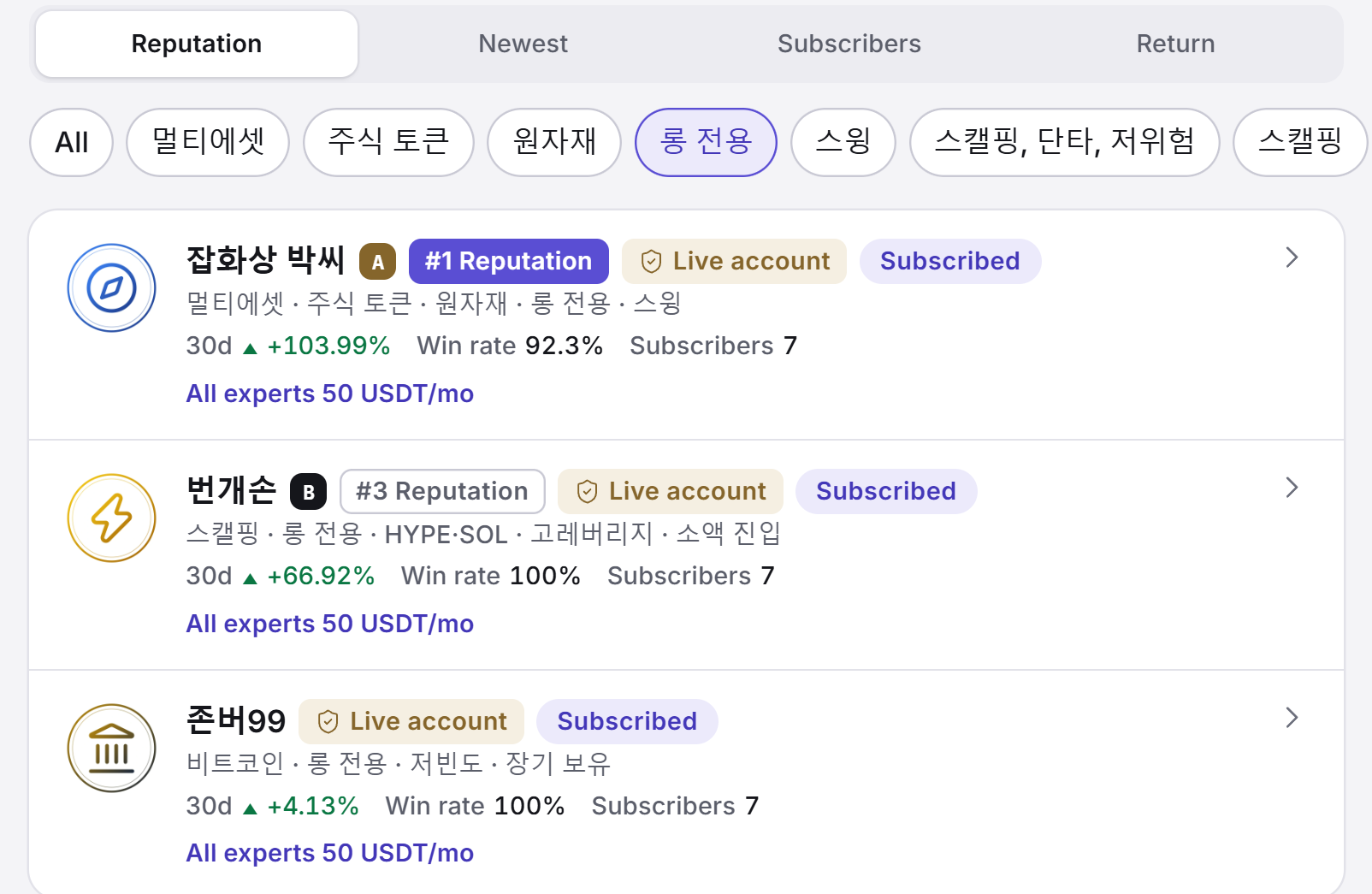
- 잡화상 박씨: moves across multiple assets and holds long as a swing trader. Also trades stock tokens and commodities.
- 번개손: scalps short and often, with high leverage and small entries.
- 존버99: goes long on Bitcoin with low frequency and long holding periods.
Do you prefer alerts that come often, or only now and then? Start with the tag that matches the rhythm of your own day, and getting started gets easier.
The top of a profile: intro, active since, closed signals
Open one you like and check three things.
Open an expert and the top of the profile shows their own introduction, their style tags, when they started, and the 30d win rate, 30d cumulative return and number of closed signals, all on one screen.
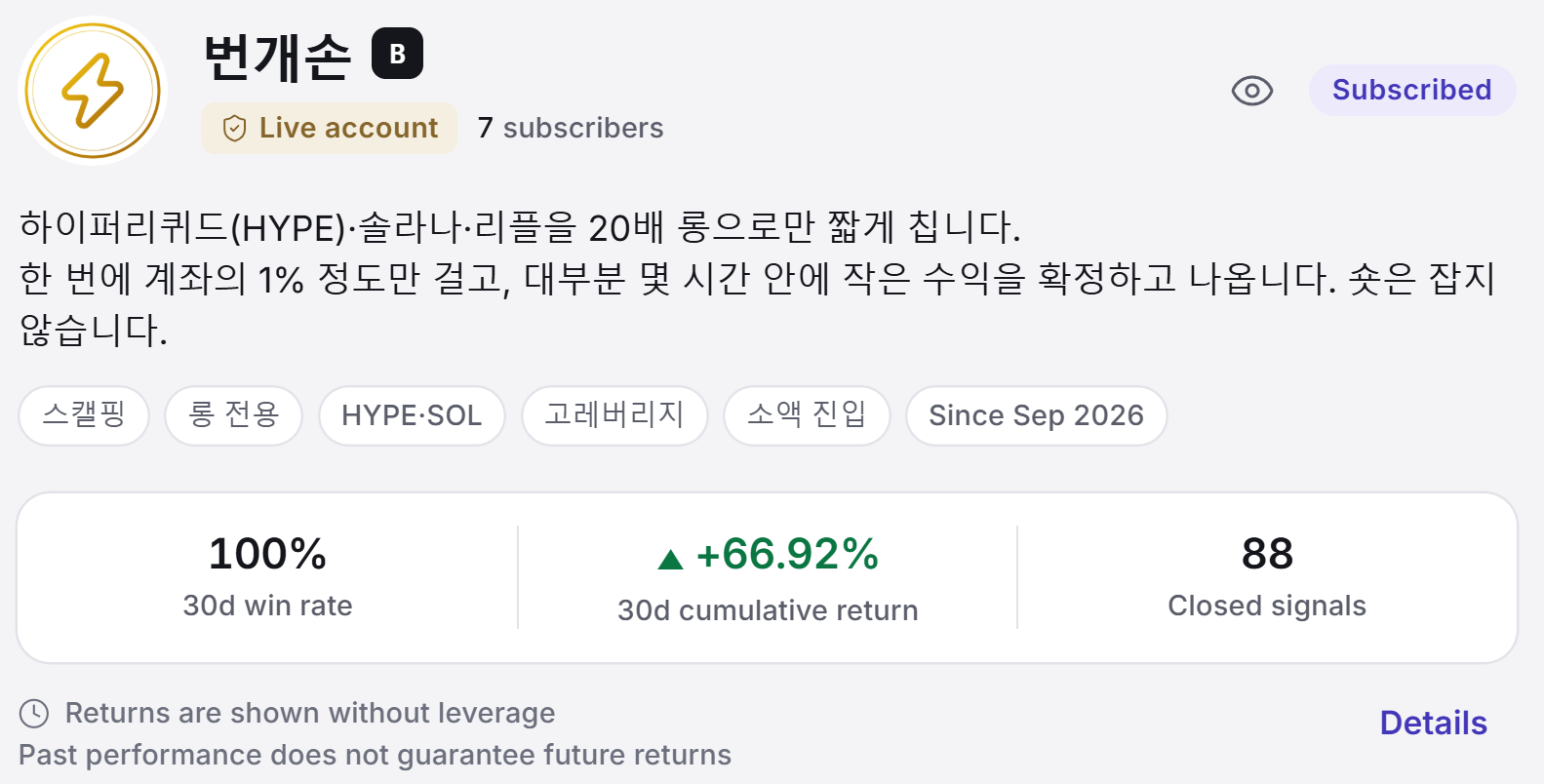
- Introduction: the expert's own words describe the method, like "I only take short 20x longs, and I put in about 1% of my account at a time…" (written in Korean on the screen).
- Active since: "Since Sep 2026" tells you at once how long the record has been building.
- Closed signals: this profile shows 88. Look at how many signals a number is built on.
How to read win rate, cumulative return and reputation score is covered in detail in episode 4, how to read the metrics.
This order gets you there fast
Tag, grade, intro, count: four steps are enough.
- ① Style tag: keep only the styles that fit your rhythm.
- ② Grade and reputation rank: check them. An expert without an A, B or C badge gets one once more signals have closed.
- ③ Introduction: read it and see whether you like the way they trade.
- ④ Closed signal count and active period: gauge how thick the record is.
When you find an expert you like, open that person's closed signal cards in the Signals tab. From entry price to exit price, how each one ended stays on a single card.
Start with an exchange sign-up instead of a fee
You can start without worrying about the subscription fee.
Covis's subscription fee can be replaced by registering through an exchange referral.
Signing up with the Gate exchange is covered in a guide you can follow screen by screen.
Narrow the list with a style tag to the experts that fit your rhythm
You can sort by Reputation, Newest, Subscribers or Return
Filter once more by the grade and reputation rank next to the name
Check the profile's introduction, active-since date and closed signal count
In episode 6, we pair which experts suit which style
Next, episode 6: matching by style. How to find the pro who fits you among scalping, swing and long-term holding.


